|
ArtInfo: "Showing is Proving and Proving is Nothing But Fear": A Q&A With Rocker and Painter John Mellencamp
05.18.2012 - By Chloe Wymal
ArtInfo
Musician and working class hero John Mellencamp is the quintessence of
homespun, blue-collar Heartland Rock. It might come as a surprise that
Mellencamp — who ditched the “Cougar” moniker in 1990 — is also a painter, and a
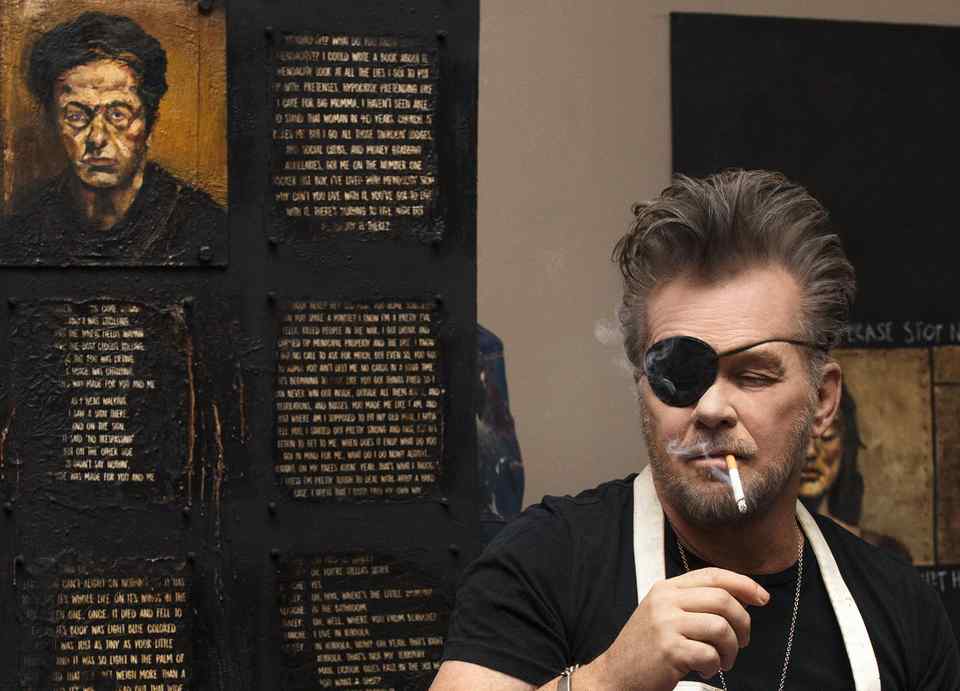
prolific one at that. The Tennessee State Museum's current survey, titled
"Nothing Like I Planned: The Art of John Mellencamp" showcases a selection of 48
paintings spanning four decades of output. Taking cues from sources as varied as
Chaim Soutine, Otto Dix, and Jean-Michel Basquiat, Mellencamp’s paintings range
from tempered portraiture to violent gestural compositions incorporating text
and graffiti. Mellencamp says his art and music are interrelated. Sure enough,
elements of Rust Belt populism appear in his paintings. See, for instance, “MLK”
(2005) where croweded, black figure vies for dominance in a crowded picture
plane crowded with crosses and graffiti scrawl reading, “Martin Luther King had
a dream and this ain’t it.” Other works are introspective self-portraits and
pictures of friends.
Before he became the rock star behind jukebox staples like “Jack and Diane”
and “Pink Houses,” the Indiana native came New York to pursue creative
endeavors. Unable to afford tuition, he was forced to put his art aspirations
put on hold. In 1988, he returned to the Art Student’s League with multiple
charting albums and some preliminary instruction from painter Joan Royce under
his belt. He took classes and private lessons with portrait painter David Leffel,
who taught him Rembrandt’s painting techniques.
Mellencamp and I were supposed to talk about his art show, but we ended up
covering a lot more than that. The straight-talking and gravelly-voiced artist
led me on a meandering conversational path, littered with F-bombs and
extemporaneous nuggets of wisdom. I spoke with Mellencamp about art, life, and
the crucial importance of Marlon Brando.
You studied painting at the Art Students League in New York —
Here’s the way this goes. I went to New York in 1974, to either try to get a
record deal, get into the New York Art Student League, or be a dancer. [Laughs]
So that was my plan. Some plan. And I had no money.
What kind of dancer?
A Broadway dancer. And I had no plan. So the first place I went was the art
student league and, well, that plan was dashed because I didn’t have any money.
Then I found out that all I had to do was submit a tape of me singing, I could
afford that. And then I got nowhere in the dancing field. But I have to admit, I
did try.
Just as folk music is the foundation of your songs, German
Expressionism is the foundation for your painting. You’ve said, “discovering Max
Beckmann was like discovering Woody Guthrie or Bob Dylan.” Is there an affinity
between these styles? What draws you to them?
I would say so; because the thing about Beckmann’s paintings was that he was
painting a Germany that Hilter didn’t want to see. Woody Guthrie was singing
songs that America didn’t want to hear. Woody Guthrie wrote, “This Land is Your
Land” in response to “God Bless America.”
Yeah.
You didn’t know that. Don’t go, “yeah.”
I did know that. [Laughs]
You did not. No! [Laughs]
Do you like Guthrie’s drawings?
Yeah, they’re like his songs. It’s like he drew them with a piece of barbed
wire. I like his drawings because they are honest depictions of who Woody
Guthrie was. And that’s an important thing.
Your paintings are sometimes political. Can you tell me a little bit
about your Martin Luther King portrait?
Well, that’s not so much a portrait as a feeling, isn’t it? There’s no
attempt to make it look like King, but the message eclipses the physical
likeness. A painting has to be beautiful. Even in its grotesqueness. That
painting is grotesque but I think it’s still beautiful. There are a lot of songs
that are that way. That are like, “oh fuck, I don’t really want to hear this."
But I’ve got to. It’s beautiful for that reason. I think that that painting
falls into that category.
It resembles a Basquiat in some ways. Was he reference for you as an
artist?
Yes, but even more than that. I travel all the time, and I see all this
street art. And, you know, I use a lot of stuff from street art. I mean, sure,
you have to pay attention to him because he was the greatest street artist of
that time. So you have into include him in the mix. But I wouldn’t include him
in the mix with Beckman or anybody of that nature. Otto Dix or somebody like
that. You know Basquiat; his paintings all fall into that category, grotesque
but beautiful.
When did you discover street art?
I was in New York in the '70's. Before you were born! You would not believe
what that fucking place looked like, particularly if you saw a subway train. It
was a joke. You couldn’t even see the train! I mean the train was entirely
covered with graffiti. You have no idea what New York looked like in the
seventies. Time Square was dangerous. It was a dangerous place to be. But, I
have to say; I liked New York better in the '70's. But I was a kid in the '70's.
Times Square is like a big outdoor mall now.
Yeah, well that’s probably what it should be for today’s society. But you
went down there and it was one pornography place after another, graffiti
everywhere, nothing worked.
Where did you used to hang out in New York?
I don’t hang out. I’ve never hung out. Hanging out is a waste of time. The
only time I would hang out was when I was a kid, I would hang out in the
streets. But once I started making records, I stopped hanging out. If I’m
painting, I paint every day. I’ll be up in the studio from 8:00 in the morning
to 8:00 at night.
Are you currently painting?
Yes. I haven’t painted today, though. I’m trying to get my kid on the
football team at Duke, so I’m kind of busy with that.
Recently, you’ve moved away from your crowded, text-heavy pictures. Paintings
like “Savannah” and “MMEAEH” seem to revisit to the austerity of your early
portraiture. Why the change?
I just got tired of painting that way. Those paintings were cumbersome and
there was a lot of math involved in those paintings.
What kind of math?
There’s math in everything. I’ll explain it to you like this, if I came into
your apartment, I’m sure I would redecorate it. Because I’m sure you don’t have
the math right. Let’s take your living room and take all the furniture and shove
it towards the street. Let’s just show all of it. Wow, we got a lot of room
don’t we?
Yeah.
We got a lot of room, but it’s not very fucking attractive is it? Looks like
hell. Let’s start over, let’s place this here. This area takes up this much of
the cubic space. So it’s all a math problem. So ifthis chair is this big and you
set it here, then it occupies this much area. Then something has to offset that
chair space over in this area to occupy that space. And a canvas is exactly the
same; lyrics in a song are the same. You can’t put 9,000 words in four measures.
You can’t put 9,000 drumbeats in four measures. You can’t put 9,000 base licks
in four measures. You can’t put 9,000 pieces of furniture in your living room
because it gets all crowded and the math gets all fucked up. Everything is math.
Were you involved in hanging the show?
I went down with Renee [curator Renee White] and spent an afternoon. We kinda
set the show up together. I’m like you. I’ve never seen the paintings hung.
You weren’t excited to go to your own opening?
No. I have no interest in shaking anybody’s hand, or hanging on anybody’s
cross. I’m not trying to make a point. I’m not trying to draw any lines in the
sand. All I’m doing is painting. It’s my hobby. And that’s that.
It seems like you’re not very interested in self-promotion. How did this show
even happen?
I’m friends with Bob Dylan and Bob was at my house, and he said, “What are
you going to do with all this shit?” and I said, “I don’t know.” He said, “Well
why don’t you sell it?” I said, “To who? Who am I going to sell it to?” And he
said, “Well, why don’t you at least show it?” and I said, “Well, ok.” Bob’s also
a painter, and he said, "Well I know a guy who knows this guy." And so we called
this guy and this guy came out and looked at my stuff and said, well, "maybe we
can do this." And I said, "Yeah, I know that, being a musician, people are going
to go, “oh fuck.” I get that. I could probably paint the fucking Mona Lisa — any
musician could probably paint the Mona Lisa — but it wouldn’t be viewed as the
Mona Lisa. It’s like, “Ah! This guy’s a fucking singer.” And I understand that.
There are a lot of actors who try to get records made and try to make record
deals, and everybody goes, “Ugh.” It used to be expected in the entertainment
business. I mean look at Sinatra, Bing Crosby. All these guys stared out as
singers.
But they were always pretty much playing themselves.
Yeah, but we liked him. When did Jimmy Stewart not play Jimmy Stewart? When
did John Wayne not play John Wayne? But that’s what we like about them. When you
talk about acting, you really have to respond to somebody’s personality. If you
like the personality and the image that they’re projecting, that doesn’t mean
that that’s how they really are. Look at Henry Fonda, for example, everybody
loved Henry Fonda but, if you talked to his kids, they didn’t love him! They
didn’t love him so much. It’s whatever they project, you know. Marlon Brando is
the same thing. Fucking Brando, everybody loved Brando. But I don’t think his
kids loved him very much. You need to know the twisting and turning of the
greatest actor that we’ll ever see in our lifetimes. There are a couple of
really good books on Brando. If you don’t want to read a book, there are a
couple of really good videos that have been made about him. Have you ever seen
“Street Car”?
No.
Ok, well, here’s my advice to you: Tonight. Or this weekend, if you don’t
have anything to do, go rent “A Streetcar Named Desire” and watch it. And you’ll
go, “Oh My God, I’ve just seen the greatest actor in the greatest play of my
life.” And that shouldn’t be hard to do at 22.
I liked him in “Last Tango.”
Me too. But is “Last Tango” his best work? No. It’s an odd, quirky movie.
But, watch “Streetcar” or watch “The Fugitive Kind,” and you’ll go “Oh Fuck.”
That’s as good as it gets.
Do you collect art?
Yes I do.
What artists do you collect?
Do you want people breaking into my house? [laughs].
What styles or genres are you attracted to?
Some of the people that you’ve named.
What’s you’re favorite place to see art?
Any place. I’ve seen beautiful art on the sides of buildings. I’ve seen
beautiful art in museums. I’ve been beautiful art in galleries. Beautiful art is
everywhere. Fucking look out the window, man! If you can’t see something to
paint or to write about just looking out your window, they maybe you better
consider a different vocation. There is so much to write about, there is so much
the paint. The job is never done. It’s never going to be done. There’s already
enough songs in the world. We don’t need any more songs; we don’t need any more
paintings. There’s so much right now we can’t even look at it and comprehend
what’s there. We don’t really need it — but it’s nice to have it.
You’ve made hundred and hundreds of paintings. Do you have any
personal favorites?
Not really. There were some paintings in the '80's and I have given away or
sold. I wish I hadn’t have done that. At the time, they were just taking up
space and I was like, “get this shit out of here.” So I would just give it to
people or just sell it for practically nothing, just to get it out of my studio.
At one point there were 500 paintings stacked up in there. And then I paint over
stuff all the time, which drives my girlfriend crazy.
Your girlfriend asked you if you were proud about having an art show.
And you said, “No, not really.”
Well, it’s nice if people like it [my art]. I’m successful as a painter
because I’ve done it. It’s the act of doing. That’s the success. If you’re going
something just to be famous, you’re going to be very disappointed. And in this
culture today, people will do anything to be famous. They will get on TV and
show their ass, you know. I am against that. I am at complete odds with that.
Quite honestly, they had to break my arm to do this interview. I don’t like to
really talk about myself. I’m 60 years old. I’ve been making records since I was
21 years old. After a while, it’s like, I don’t want to talk about myself. John
Mellencamp is just not that important.
You don’t have anything to prove.
Showing is proving and proving is nothing but fear.
Thanks for taking the time to speak with me.
You’re so welcome. And what’s the one important thing that we talked about?
“Streetcar.”
You got it!
"Nothing Like I Planned: The Art of John Mellencamp" runs through June 10 at
the Tennessee State Museum
|