|
|
 |
Arkansas Democrat-Gazette: Rumble and Howl - Four-disc Mellencamp Retrospective Shies From Hits, Goes Deeper
08.09.2010 - ArkansasOnline.com - By Ellis Widner
LITTLE ROCK — In five words - On the Rural Route 7609
- John Mellencamp captured the essence
of his life and career.
“I started making records in ’76, and the most recent track on the collection
was done in ’09. So Rural Route 7609; it’s like an address. I thought it sounded
cool,” Mellencamp told writer Anthony DeCurtis.
On the Rural Route 7609 (Island/Mercury, $99.99) is a four-CD retrospective. The
title, DeCurtis says, has a deeper meaning as well.
“For anyone interested in finding the real John Mellencamp, this is where he’s
been, and where he lives,” DeCurtis writes in the album’s exceptional liner
notes.
That is the key to understanding the music and the man, or misunderstanding
both.
Throughout his career spanning more than three decades, Mellencamp has not been
taken as seriously as his music should have commanded.
Why not? Was it because the Indiana native singer-songwriter had, as Neil Young
suggested, too many hits?
“There’s a danger to that because then it’s just about the hits,” Young said.
Did “Jackand Diane,” “Pink Houses,” “Hurt So Good” and so on rob Mellencamp of
respect as they enriched him?
Success does have its price, especially if you want - when you demand, as
Mellencamp does - to be taken seriously.
Maybe we were caught up in the hits and just didn’t pay attention to the other
songs.
Could his beginnings as Johnny Cougar - a name that sounds tailor-made for
teenmag covers - be a factor?
“If they wanted to call me Rumpelstiltskin, I would’ve done it to have the
opportunity to make records,” Mellencamp said during his 2008 induction into the
Rock and Roll Hall of Fame, referring to a name he didn’t choose and its
evolution back to his family name.
Maybe it’s because he was a brash and outspoken guy from the sticks, which
carries its own cultural baggage in the ages-old blue blood/blue collar dynamic
manifest in many of the songs and stories of our popular culture.
Mellencamp’s sharp social observations, his heartfelt singing, his willingness
to be tough and vulnerable, his plain-spoken style and his populist politics are
amply displayed on this ambitious and perception-altering boxed set.
It’s easy to see ourselves in Mellencamp’s songs, to feel what he’s feeling.
That’s due in no small part to the fact that after he became famous, he chose to
stay home, in Indiana. He didn’t run from his roots to a mansion in the
Hollywood hills. Rather than distance himself from the world and his raisin’, he
embraced it. That’s how he stays in touch: He sees howpeople struggle firsthand.
And, as the songs make clear, he has struggles of his own.
As happens with other artists, Mellencamp’s music has had its ups and downs. In
the 1990s, he had several uneven albums and some well-known dust-ups with record
executives. (“It’s not about ego. It’s about being passionate and standing up
for yourself,” he says in the liners.) He also had a heart attack and went
through a divorce along with the death of his close friend, writer Timothy
White.
Mellencamp’s creative revival came when he discovered his musical DNA during the
research and recording of 2003’s Trouble No More, a set of American roots music
that would inspire him to do the best and boldest artistry of his career.
The impact of Trouble No More and his creative rebirth showed brilliantly on
2008’s Life Death Love and Freedom. Eight songs from what is arguably his best
album are on this set. At a time when many are content to coast along and rehash
the past, Mellencamp is going boldly forward.
On the Rural Route 7609 clearly shows Mellencamp’s place in the continuing
fabric of songwriting and the storytelling lineage of Woody Guthrie, Pete Seeger
and, yes, Bob Dylan.
It does so in an unconventional fashion. Rather than build a retrospective with
hits as a reference point, Mellencamp cast most of them aside.
Without the seduction and distraction of familiarity, we listen closer.
If you’re looking for hits, get 2004’s Words and Music.
But if you are ready to dig into the substance of a writer, this trip through
the back roads of Mellencamp’s career is a revelatory and inspiring journey.
The 54 songs of Rural Routeare not organized chronologically, but sequenced with
others that share a similar theme or thread. There are some unreleased songs,
some alternate versions. And a couple are live readings that shift perceptions
yet again.
Listening, it becomes clear what a profound influence Mellencamp has been on,
for example, the Americana movement and contemporary country with his embrace of
rootsy instrumentation on albums such as 1985’s Scarecrow and 1987’s The
Lonesome Jubilee.
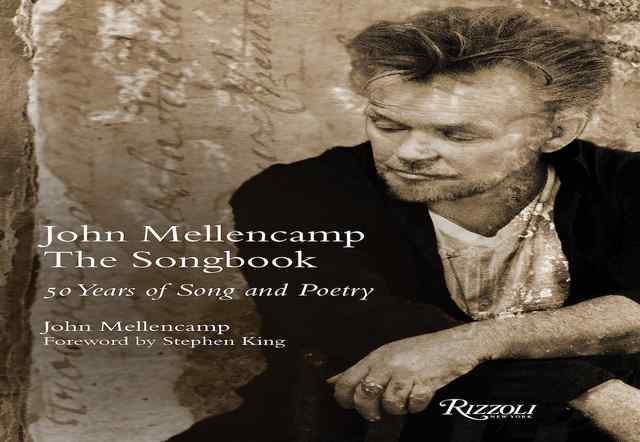
On the Rural Route 7609 is presented as an oversize hardcover book, with a
superb essay by DeCurtis that gets into Mellencamp’s mind-set, a track-by-track
commentary, the songs’ lyrics and excellent photographs.
This handsome sepia-hued package enhances the experience of listening to the
music; again, urging us to take thisseriously. Why else would we see two
page-size passages from playwright Tennessee Williams, whose character Big Daddy
from Cat on a Hot Tin Roof inspired Mellencamp’s “Big Daddy of Them All”?
Just how seriously becomes clear with his choice of the opening tune of the set,
the moving “Longest Days.” This first disc largely reflects on death and our
culture’s darkness and violence.
“Longest Days” was inspired by his grandmother’s illness and death and her
telling him, “Life is short, even in its longest days.”
It becomes a reflection on life and career: “So you tell yourself, you’ll be
back on top someday/But you know there’s nothing waiting up there for you
anyway.”
Then we hear his grandmother singing the traditional song “The Baggage Coach
Ahead,” a song Mellencamp says she sang to him as a child,followed by Mellencamp
on the same tune. The love and appreciation he feels for his grandmother is
palpable and deep.
The chilling “Rural Route” (from 2007’s fine Freedom’s Road) may be Mellencamp’s
bleakest. It tells the real-life story of a fifth-grader who is traded by her
father to a man for drugs. The 10-year-old girl is raped and murdered in a rural
area where “air stinks of crystal meth,” not far from the home of Mellencamp’s
parents. Still, the horrific tale ends with the singer asking God to “show us
the will ... Give us the mercy for the drug-addicted/And the mentally ill.”
It’s one of several songs where Mellencamp takes the idealized vision of rural
and small-town life as a refuge from the meanness of the world and turns it
inside out.
As one of the organizers of the fundraising concert Farm Aid, Mellencamp’s
activism for family farmers gets deeply personal on “Rain on the Scarecrow”
(here, in an acoustic version from Rough Harvest). In the story about a family
losing the farm, Mellencamp captures the sadness and anger with cutting lyrics:
“Called my old friend Schepman up to auction off the land/He said John it’s just
my job and I hope you understand/Hey callin’ it your job, ol’ hoss, sure don’t
make it right/But if you want me to I’ll say a prayer for your soul tonight.”
Songs such as “Rain on the Scarecrow,” “Ghost Towns Along the Highway” and
others seem filled with a yearning for the America of Mellencamp’s youth, one
that no longer exists. Yet, in the liner notes, he admits this nostalgia blinds
us; one person’s fond memory is another’s hellishvision.
“Jim Crow” was sparked by Mellencamp’s reaction to a TV talking head saying
America has come a longway on race relations. “I don’t think we’ve come that
far,” he says in the set’s essay. The song is powerful in both versions here -
as poetry read by Cornel West and as a duet with folk singer Joan Baez, who
marched alongside Martin Luther King Jr.
There’s a song that had fans worried in 2008 that Mellencamp might be dying. On
“Don’t Need This Body,” he sings: “All my friends are sick or dying and I’m here
all by myself/All I got left is a head full of memories and the thought of my
upcoming death.”
The first CD closes with a cool “Jack and Diane” trilogy that reveals its
evolution: “Jenny at 16,” the beginnings of the song; a writing demo; and the
album version of the hit single.
Actress Joanne Woodward opens the second disc, reading “The Real Life,” bringing
her 80-plus years of life experience to the lyrics and a new depth of meaning to
the song.
This set of songs seems to explore Americans’ shifting and often conflicting
sense of identity. Here we find Mellencamp’s most political material, including
his commentaries on the economic situation (the unsettling “Troubled Land”) and
controversial takes on Presidents Ronald Reagan and George W. Bush (“Country
Gentleman,” “Rodeo Clown”).
But “To Washington,” Mellencamp’s rewrite of a 1920s song, made him the object
of death threats at a time when the Dixie Chicks were at the center of a
firestorm and the cultural divide that grew from the Iraq war was becoming a
chasm.
A rootsier take on 2007’s “Our Country” seems to echo a patriotic theme. But
listen closer and you’ll hear lines such as “Poverty could be just another ugly
thing/And bigotry would be seen only as obscene/And the ones who run this land
help the poor and common man.”
The song, which was licensed to Chevrolet for a commercial to attract attention
to his album Freedom’s Road, was overexposed. And the song’s message, described
by DeCurtis - “if this is indeed our country, that ownership comes with a
responsibility to make it live up to its ideals” - was lost. The sparer version
here serves it well.
The third disc is more personal. An alternate version of 1989’s “Void in My
Heart,” which was recorded at Chess Studios, is autobiographical: “Well I poured
miles of concrete and strung wire for telephones/Dug ditches when I was a young
boy and I first left my parents’ home/Sang my songs for millions of people, sang
good and bad news/Now there’s a void in my heart and a fire at my fuse.”
One of the pleasures of the fourth disc is a new song, “Some Day the Rains Will
Fall,” from the sessions for his forthcoming album No BetterThan This. It was
recorded in the Houston hotel room where bluesman Robert Johnson recorded many
of his songs. It’s a powerful aperitif for the new album, due Aug. 17.
The set closes with a second version of “Rural Route” with an added verse, a
coda of sorts for those involved and, perhaps, rural America: “Father’s been
brought up on charges on the rural route/ Young man awaiting death sentence
conviction from the rural route/Loneliness and isolation on the rural route/
Slowly change the look of this nation from the rural route.”
In the commentary on the song, DeCurtis writes: “Whatever redemption we may be
able to find in this hard world lies in our understanding that all our lives,
our best virtuesand most shocking vices, are bound together by our common
humanity. And only compassion can save us.”
These are the lessons learned growing up on the rural route.
Back
|