|
|
 |
UK's Classic Rock Magazine In-depth Mellencamp Interview
01.08.2009 - It’s Johnny’s birthday. He’s 57 today and life is swell for Mr. John Mellencamp.
He’s staying in Claridge’s Hotel on Brook Street London – and that ain’t cheap.
God knows what his suite cost, because a ham sandwich is 11.50 pounds sterling.
VIPs stay at Claridge’s don’t you know – there’s security on his corridor. Not
for him and not even for Samuel L. Jackson, who’s in the adjacent room. The
hired muscle is for Mary-Kate and Ashley Olsen, the winsome twins from Sherman
Oaks currently enjoying a shopping spree on Bond Street, where famous rappers
and over-fed politicians are embracing the credit crunch with gusto. Walking in
this neighborhood, you don’t know whether to carry an autograph book or a
powerful handgun.
But here’s Johnny and his lovely wife Elaine Irwin Mellencamp, a former
supermodel turned super-delegate and glowing face of Almay Cosmetics. There’s a
minor problem in the household – no piano in the suite. “Should we change
suites, honey?” John asks. “I dunno, baby. Do you need the piano?” He doesn’t
really, “I need a shower,” says John, grabbing himself a bottle of water and
firing up an Americans Spirit. Rock stars who smoke – unusual these days. And
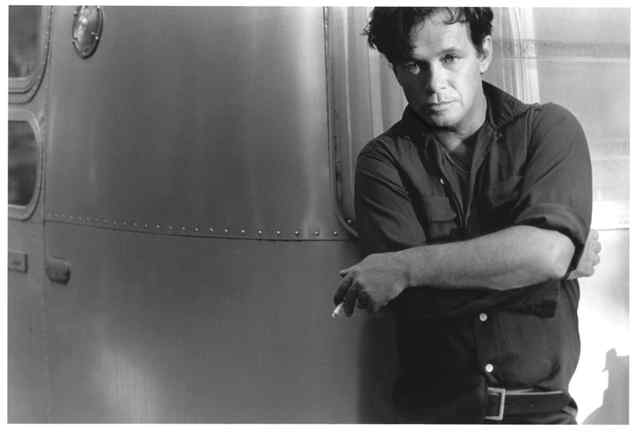
John’s looking good: big, dark quaff, leather jerkin, white tee, blue jeans and
work boots; he’s a man o’ the people crossed with Martin Sheen in Badlands doing
a James Dean impersonation. While I admire John’s biceps and examine his faded
tattoos, he comments on my vintage Sony Talkman. “I got exactly the same
machine, only with a better mic than yours. I record all my albums on it.”
By way of an icebreaker we talk about London which John knows well, since he
lived here for 18 months from 1977, in a rented house in Chelsea found for him
by his friend, the late Mick Ronson, “You’d have to search hell to find someone
with a bad word to say about him,” John remarks.
Now 30 years on, Mellencamp has noticed that “you Brits have changed. You got
bigger and fatter. When I was here everyone was lean and fait. Not that they
worked out, but they walked everywhere and there was no McDonald’s. I checked.
When I went back to the States I thought: “God, people here are so fat,” Now
you’re filling out. It’s your diet. Too much starch. There’s King Corn in
everything.”
John’s got mixed feeling about England, “because my first two managers were
English”, They were Tony DeFries (known as Deep Freeze to his friends) – the
Main Man svengali who masterminded David Bowie’s career in the 70s – and Billy
Gaff, who did the same job for Rod Steward And The Faces. “Lemme tell you about
England. You stole my money, you took my publishing and you changed my name. So
not only was I broke, I had absolute zero credibility. It took me 15 years to
get my money back – I still haven’t got it all – longer still to get over the
fucking Cougar thing.”
Oh yes. It was Tony DeFries who christened him Johnny Cougar, for reasons
unknown. (Classic Rock wonders if the name was inspired by Johnny Cougar,
Redskin Wrestler, a character in Tiger comic.) On his first album Chestnut
Street Incident, the singer was plastered in makeup and made to look like an
effete teen idol, a'la Bobby Vee or Ricky Nelson – that’s if they’d been rent
boys in Spanish Harlem. “That was quite a culture shock for a boy from a small
town in Indiana,” John recollects, “I’d been rejected by every record company in
New York before I went to MainMan. The reason I tried them is because when I was
a kid I read Creem magazine and they wrote about everything that was alien to
small-town boy – Iggy Pop, Lou Reed, Moot The Hoople, David Bowie and The New
York Dolls. I loved all the stuff. We used to play the glam songs in my early
bar bands in Bloomington where I grew up as one of 9,000 people. That Creem
world out of Detroit was the most important thing to me.”
On the verge of quitting the business, Mellencamp chanced his arm at MainMan. “I
walked in and got lucky because the receptionist, who was a woman incidentally,
thought I was handsome. Plus she came from the Midwest like me. She actually
walked my tape into DeFries’s office. I drove home 20 hours in the car, and when
I got in there was a message from MainMan’s president, Jaime Andrews, who said
he’d listened to the tape and wanted to put it out. Could I come back to New
York immediately? I phoned him and said: “I ain’t got no money.” Didn’t matter
‘cos he sent me an airline ticket and booked me in to a hotel. I met DeFries and
he asks: “Have you written any songs?” Yeah, two. ‘Okay,’ he says. “Here’s
$30,000. Go home and make some demos.” I thought: “Thirty grand, that’s a lot of
money” and I almost decided to take the cash and fuck off. Buy a new car or
something. But I didn’t do that. I made my demos and took ‘em back and then I
met Mick who hired me a band, including him and the pianist Michael Kamen, a
real fucking hot shot.”
Ronson was on tour with Bob Dylan’s rolling Thunder Revenue at the time. “But he
still played guitar for me. What a fantastic guy. He fixed the songs and DeFries
put ‘em out. I thought they were just work in progress. No, they were good
enough. He gives me a deal on the spot and few months later the album comes out
with that cover and that name. Why Cougar for fuck’s sake? You English guys are
into the star-making thing – David Jones, Adam Faith. But I said: ‘I dunno about
this, Tony. I don’t like this name and the cover is horrible,’ He shrugged:
“Take the deal or piss off.” I kinda like him, though. He was a very cut-glass
English barrister.”
Mellencamp landed at MainMan when the company was in freefall. Bowie had sacked
DeFries and was holed up in a hotel room ingesting vast amounts of cocaine and
living on milk. DeFries had sacked Iggy and Mott The Hoople. The only people
left were Bowie’s old back-up team: hangers on like Leese Childers, Cherry
Vanilla, Dana Gillespie and an assorted ragbag of post Velvet Underground queens
transvestites and ne’er do wells. A fantastic time, in other words.
“I was at the bottom of the totem pole but DeFries decided to use me to get his
own back on Bowie, which was never going to work. When all the chips fell there
was just me and Ronson left, so the atmosphere was weird to say the least. The
offices were staffed by a bunch of very nice gay people. I liked those guys:
they made life there more tolerable. Nice, smart, caring guys. Even so, I had
zero power. Of course I never met Bowie then. They took all his pictures off the
wall and his name was a forbidden word. I did meet him 10 years ago at Jann
[Rolling Stone Editor] Wenner’s 60th birthday bash and we talked about the
company, DeFries and Mick. I had a good evening. Bowie was very funny.”
So in the mid 70s John Cougar Mellencamp was hanging out in New York with the
remnants of the Andy Warhol crowd, going to Max’s Kansas City and CBGB’s, seeing
the Dolls and catching Talking Heads before Sire signed them. “Which was great
except I was going nowhere. The album only sold a few hundred copies, to my
friends and family mostly.”
His follow-up, The Kid Inside, stayed on the shelves but was eventually released
with an even more preposterous cover than the debut. This time John Cougar (as
he was now known) resembled gay porn star who’d just done 10 rounds with Marvin
Hagler: all hot, sweaty and lipstick pouty.
As an act of kindness, DeFries had let him go and he fell into the outstretched
arms of Billy Gaff – “a very old-school entrepreneur” who insisted on the London
move. Out of the frying pan, into a nest of vipers. By now he’s decided to be a
folk singer. “Which considering I arrived at the height of punk wasn’t a good
idea. I went to the Vortex one night with Ronson and we nearly got the shit
kicked out of us because he was wearing a satin jacket and platform shoes and
had long blond hair and I probably had a guitar over my should. We went to see
the The Stranglers.”
He liked London but soon found Gaff wasn’t averse to taking liberties. “In those
days the English were very good at managing people, and owning their publishing,
which is illegal. They took advantage but I figured, ‘You own everything, I got,
so what the hell’, I had no choice see, no selection choice. Gaff impressed me
‘cos of the Rod Stewart thing, but he was very adept at not answering my calls
or even seeing me at all. Plus he put me on this Warners offshoot called Riva,
which was the shittiest little label ever. But I couldn’t take out a character
reference.” He says crossly. “It was either take it or quit and fuck off. When I
left Riva and went to Los Angeles after making A Biography (cover shot of John
in a suit looking like Duran Duran’s hairdresser, he was back to Johnny Cougar
for this one), I had five contracts I couldn’t get out of and one hit single in
Australia. I Need A Lover, which I never saw a cent from. I told Gaff: “We’re
done here.” He replied: “You don’t like me, but you’re stuck with me.”
Being big Down Under made Mellencamp realize he needed to make something that
was so painfully commercial, “so full of shitty little pop songs” (as he rather
bluntly puts it) “That no one could fuck with me, since no critic ever took me
seriously. In the next few years I wrote the hits, Hurts So Good, Hand To Hold
Onto, the American Fool album and, of course, Jack and Diane. I went from being
a fucking joke to being one of the biggest pop-rock stars there ever was. At one
point I had two singles in the American Top 10 and the No. 1 album. You know who
the only other person to do that is? John Lennon. So I’m in the history books
and I’m still with Gaff.”
Success brought a kind of freedom when Mellencamp was rescued from music
business slavery by Allen J. Grubman, the intriguingly named show business
lawyer whose clients include Madonna, Bruce Springsteen and Sting. “Allen’s a
tough guy, like Allen Klein. He said: “I can get you out of this.” Finally I was
able to write some better songs. Not that Jack And Diane is a something I
regret. That song did well for me and it’s pretty good anyway, as an account of
a couple of high-school sweethearts goes. I was also writing stuff like Pink
Houses which was kinds political but wrapped in an ‘ain’t that America’ vibe,
which made it work for the mainstream. I was huge, so I decided to write what I
wanted. I think I invented that whole “No Depression” thing with the Scarecrow
album, though I don’t get the credit. By 1985 I was made. My only enemy was
myself.”
For reasons unexplained, the artist formerly known as Johnny Cougar was still
suffering from an inferiority complex, or something akin to an identity crisis.
It wasn’t until his 11th album, the rocked- up Whenever We Wanted, that he used
his own name, having flirted with every possible variation of his DeFries
moniker. At least now he had some control over his image and was depicted on
album sleeves looking butch with a cigarette, embracing scantily clad women in
bordellos and his future wife Elaine.
In 1995 Mellencamp paid for his four pack –a-day habit and his on-the-road
lifestyle with a minor heart attack during a concert at Jones Beach. “It was my
own faulty,” he admitted. “Sometimes I woke up 20 times a night to smoke and my
diet was terrible. My cholesterol level was way too high. [I thought] I’d better
sort this out if I don’t want to die young.”
Long before that he’d quit the business for two years at the height of his fame
to become a painter. “I consider myself a painter and I did then, I’d rather be
a good painter than a good rock star. In fact I’d rather be a good electrician.
My problem is what I call ‘the hungry beast inside’, By 1985 I had the mindset
that said: ‘Whaddya mean the last album only sold seven million and went five
times platinum? I forced my will on my career and let it run my life. Ruin my
life. Fame consumed me. I did the Lonesome Jubilee records and supported it with
the biggest tour in the world at that time, but I was also getting a divorce and
I was very tired. Plus, I didn’t like myself. I made a pact with the devil. It
was like that Paul Newman film. Somebody Up There Likes Me, about Rocky Marciano
where someone says: ‘You can have this soda but you have to pay for it. ‘So I
said, fuck it. I’m gonna quit while I’m ahead and I didn’t tour for five years.
I became a painter and I was committing artistic suicide. I didn’t drink much or
do any drugs but I was a terrible womanizer. The worst, I sat at home painted
from eight ‘til eight and I had millions of girlfriends. That was all I did.”
Doesn’t sound so bad. “It was bad! Had me some good times but I’m a songwriter
and I had a band who I felt responsible for, who were phoning me up and
complaining they were broke. So I did the Big Daddy album in my spare time and
then I met Elaine. When I married her I calmed down. I wasn’t like an Elton John
‘oh I quit’ type. I just took some time off.”
Mellencamp’s rebirth as a blue-collar, left-of-centre rock activist enabled him
to restore his credibility to a point. It’s to be noted that he’s frequently
described as ‘the poor man’s Bruce Springsteen’, but John’s doesn’t have much
time for his critics.
He lives in lavish Italianate-styled mansion in Indiana with several acres and
horses for his sons, Hud and Speck (he has three daughters from two previous
marriages). And some not very nice neighbors. The trouble with being a liberal
in Bloomington, Indiana is that if you raise your head above the parapet,
somebody wants to take a pot shot. “Hell, yeah. My family has had some vile
threats. I had to get the police to my boy’s school because they were being
bullied at recess after folk took exception to some of my anti-war songs. To
Washington specifically. I’ve had people rowing boats past my house screaming
obscenities. It ain’t pleasant. Here were people I’ve lived among for 30 years
and they’re pissed at me because I don’t like George Bush.”
Back in the 80s Mellencamp camp was an instigator of the Farm Aid movement,
kick-started by Bob Dylan and then made manifest by Willie Nelson, Johnny Cash,
Neil Young, Tom Petty and assorted US rock stars with a conscience about the
dust-bowl economics of the so-called Corn Belt. Ever the activist, Mellencamp
also appeared at the 9/11 Concert For New York.
“I was delighted to be involved because I see people like those guys and the way
they conduct themselves after years in the business is remarkable. Willie has
got it sussed and Neil has class. Can’t think of a nicer guy. Same with
Springsteen. I admire them all.”
In the last year Mellencamp has released what he considers to be his best work
yet, the Life, Death, Love and Freedom album, and was inducted into the Rock And
Roll Hall Of Fame by Billy Joel, having himself done the honors for the Lovin’
Spoonful. He finally feels vindicated. “The difference between who I was, Johnny
Cougar and today, is staggering. I feel like I’ve found my songwriting
characters and my own voice. You wouldn’t recognize me 20 years ago. I was so
hyper and wouldn’t understand a word I said. Ageing is a process I’m not at the
mercy of anybody.”
A lot of the detail on the new album deals with the big issues of its title in a
candid fashion. The death of Mellencamp’s idol Johnny Cash (whose portrait hangs
in pride of place in his home studio) is a possible inspiration. “I’ve seen Cash
and Willie [Nelson] playing at the height of their powers before a few hundred
people in the shittiest Executive Inns and not lose their grace. I went to
Cash’s funeral and from the private showing to the public showing of his body in
its hearse – the road was full of people who saluted as the cortege went past
the Interstate in Nashville. That was an amazing and humbling thing to witness.
I don’t put myself in that category at all but I can try.”
The latest album also benefits from the sure touch of producer T Bone Burnett
whose sparse touch brings the JJ Cale-flavoured John Cockers and the Waylon
Jennings-flavored Don’t Need This Body into a place that might even stifle the
criticism of John’s detractors.
“It might, but it don’t matter. I’m very pleased with the results and I’m my own
harshest critic, apart from my lovely wife Elaine here. She’s so…elegant and
ladylike. Not like me. I am fortunate to live my life now on my own terms. Have
I fucked up before? No, no really. Have I done everything my way? No, I didn’t
once think: ‘Is that all there is?’ But I got my career back and it’s been a
helluva ride. To be in the Hall of Fame and to make this album” Yeah, I’m proud
of those things. And now I’ve got to go and take that shower.”
Well, it’s Johnny birthday. He’s got to smell nice for the wife. He’s on a
promise and it’s time to set the Cougar free.
Back
|